
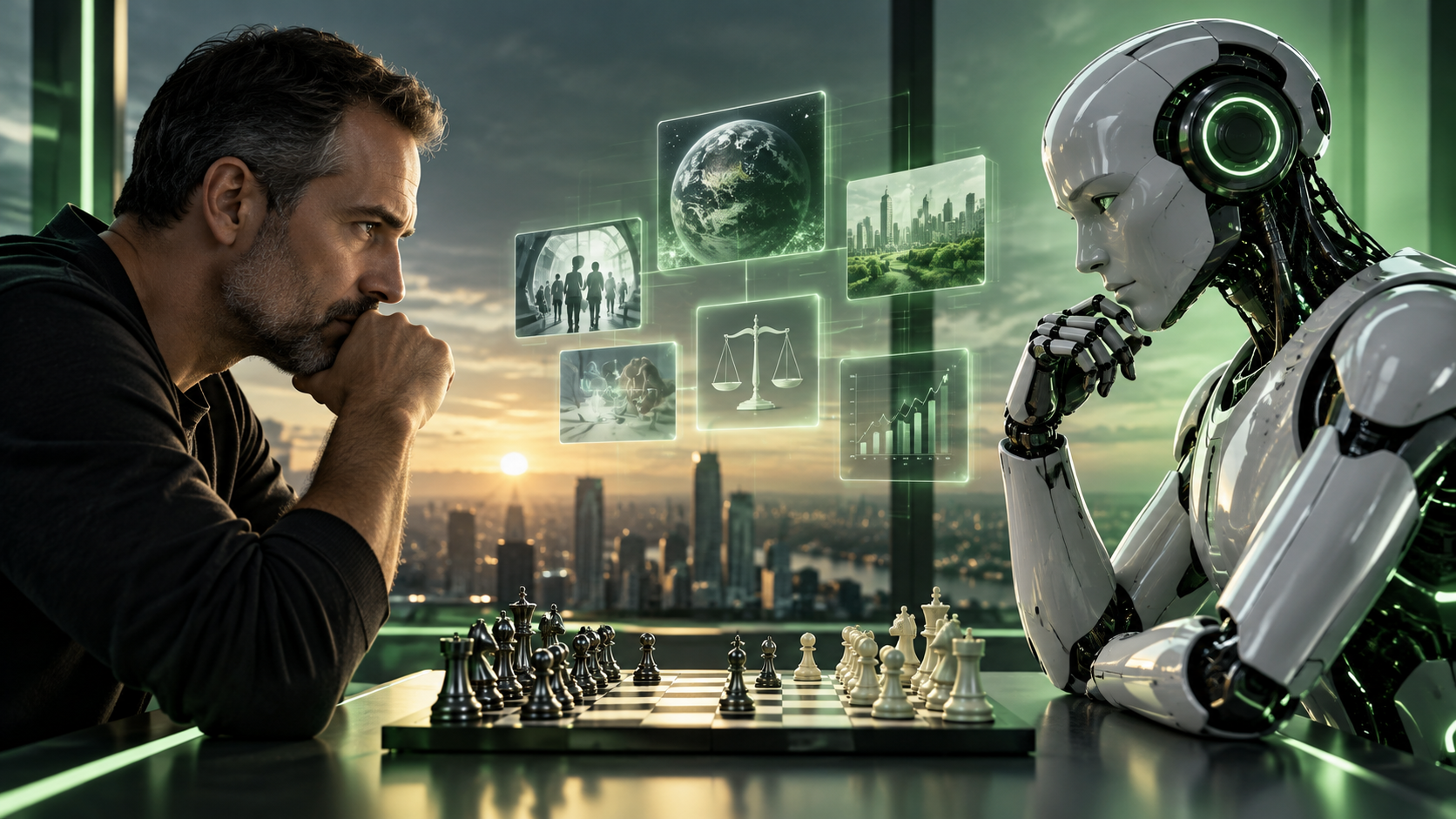
I follow the evolution of artificial intelligence closely, particularly the growing role of AI in human decision making. And I have to admit that the subject is becoming increasingly frustrating. The pace of new developments has become so relentless that keeping up with everything is nearly impossible.
Every day, the same AI companies announce new versions of their models, each supposedly far superior to what came before. New benchmark records are set, parameter counts increase, and the models become faster and more capable.
On September 3, OpenAI released GPT-6 and suggested that the era of AGI may have begun. Greg Brockman said he believed OpenAI may have achieved AGI with Astra, while ultimately leaving it to users to decide whether the model truly deserves that definition. At the end of a conversation with journalists, he declared: “Welcome to the era of AGI.”
I find that concerning, because we are entering a territory in which AI is beginning to take over activities that have traditionally depended on human intellectual capabilities.
And that leads me to a question I keep asking myself:
How far should we allow AI to think for us?
In my view, extraordinary intellectual capabilities are not enough. Before we entrust an artificial intelligence with certain decisions, it should also be capable of evaluating the consequences of those decisions and distinguishing right from wrong.
Much of what AI produces or proposes is based on knowledge generated by human beings. That applies to text, images, and even its participation in scientific fields such as drug and vaccine development.
But if human knowledge contains errors, limitations, and biases, what guarantees that the conclusions produced by AI will always be correct?
Now, let us assume that an AI becomes capable of thinking like a human being.
If it thinks like a human, couldn’t it also make mistakes?
Humans make mistakes, and AI has learned from knowledge produced by humans.
Would you trust an AI’s decisions and actions 100 percent?
Would you trust that an AI would always make the right decision and never be wrong?
What About Decisions That Cannot Be Reversed?
Consider an irreversible decision.
In countries where the death penalty exists, decisions of this magnitude are surrounded by multiple safeguards precisely because a mistake may be impossible to undo.
In a future that seems increasingly less distant, would we be comfortable giving an AI exclusive authority to decide whether a person should be sentenced to death?
Couldn’t the AI itself be led to the wrong conclusion?
In real cases around the world, miscarriages of justice have occurred because defendants were mistaken for perpetrators due to similar physical characteristics. Human systems already make mistakes. Why should we assume that an artificial system could never do the same?
Consider another example.
Supreme courts are generally composed of multiple judges because they deal with some of the most complex and consequential legal questions. Giving that level of decision-making authority to a single individual would concentrate an enormous amount of power in one person.
In a collegiate court, different interpretations can be debated, disagreements can be examined, and a case can be studied from multiple perspectives before a final decision is reached.
Would we be willing to let an AI make decisions on behalf of supreme courts?
Would it possess the judgment necessary to determine how a case should be decided while also understanding the consequences that decision could have for an entire population?
Could AI Make Us Less Capable?
There is another side to this discussion.
What happens to us if we allow AI to do everything for us?
When we stop exercising certain cognitive abilities, those abilities can deteriorate over time. Scientific research has already investigated how dependence on GPS navigation systems can influence the mechanisms our brains use for spatial navigation.
If our cars drive for us, choose our routes, decide when to brake, and increasingly handle the decisions involved in getting from one place to another, could we gradually stop exercising some of those abilities ourselves?
Research into spatial navigation provides an interesting example of how technology can influence the cognitive strategies we use to navigate our environment.
If we allow machines to do everything for us, will we still be capable of solving complex problems in the future?
Could some of our abilities actually regress?
And if so, what would that mean for us as human beings?
AI Decision Making: Who Is Responsible When AI Gets It Wrong?
There is also the question of responsibility.
When AI makes a mistake, who is responsible?
Suppose a medication is administered incorrectly based on an AI-driven decision and the patient is harmed. Who bears responsibility for that outcome?
I understand that AI can achieve remarkable performance in specific tasks and under certain conditions, including the analysis of medical images.
But would we trust everything it tells us or recommends with absolute certainty?
Could we really assume that it would never make a mistake — even when analyzing an image?
AI Should Enhance Human Intelligence, Not Replace It
I do not believe AI will ever truly possess consciousness or common sense. But even if that becomes possible someday, I am not convinced it would be a positive development.
Human beings grow by facing challenges, solving problems, and exercising creativity. We should not allow machines to replace us in that process.
AI should be used as a tool to help us confront complex problems, identify possibilities we might otherwise overlook, and make us consider ideas we had not previously anticipated.
But it should never replace human responsibility.
AI is a tool that can help us work, create, and analyze faster and more efficiently.
That is what it should remain:
A TOOL
AI can help us think.
But it should never replace our judgment, our responsibility, or our ability to make decisions.
Security decisions still require human expertise. Explore CEVACORP’s cybersecurity services to learn how we help organizations identify vulnerabilities, validate security controls, and reduce cyber risk.